Data & Research
Signal discovery starts with structural market understanding.
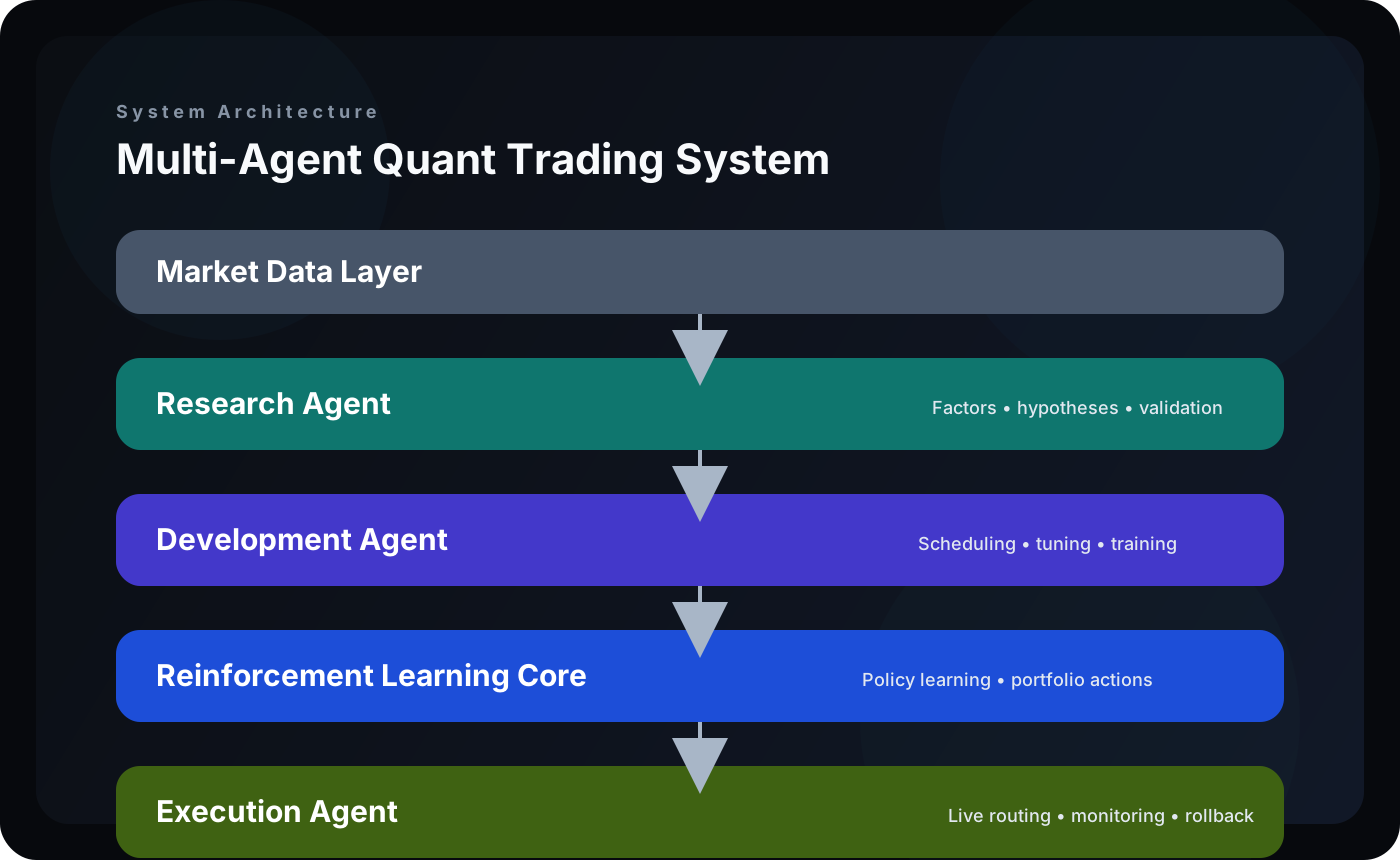
Raw market data — including Reuters sentiment, price-volume factors, fundamentals, and alternative data — feeds into the Research Agent, which is responsible for detecting structural shifts in the market. Market Perception identifies the current regime, Factor Mining uses Genetic Programming to evolve mathematical formulas that predict stock returns, and a Baseline Backtest filters out ineffective candidates before validated factors move downstream.
Development Agent
An automated MLOps layer orchestrates the research loop.
The Development Agent receives candidate factors and manages the experimentation system around them. It orchestrates parallel experiments, runs hyperparameter optimization, allocates compute resources, and monitors convergence. If a model fails to converge, the system sends a feedback signal back to the Research Agent to trigger a new research cycle.
AlphaCore v4
The RL engine turns market context into portfolio actions.
The State is built from the factor matrix combined with current portfolio holdings. A Transformer-based Feature Extractor compresses this high-dimensional input into dense representations, while MCTS plus Attention enables multi-step lookahead and dynamic signal re-weighting. The model outputs a continuous weight vector across 3,800 stocks, with a Reward function based on Sharpe ratio and risk constraints. An LLM-assisted layer acts as a guardrail across the engine, handling constraint generation, anomaly interception, and semantic validation.
Validation — MATRIX 15
Only strategies that survive multi-stage validation move forward.
Before a strategy reaches live trading, it must pass three increasingly rigorous gates across 15 markets simultaneously. In-sample testing requires Sharpe ≥ 4, out-of-sample testing requires Sharpe ≥ 3, and live trading under real-world conditions must achieve Sharpe ≥ 2.5. Failure at any stage routes an error signal back to the RL engine for retraining.
Execution Agent
Live execution closes the loop with real-time monitoring.
Strategies that pass validation are handed to the Execution Agent. An Order Router decomposes target allocations into executable instructions using methods such as TWAP or VWAP to minimize market impact. A Real-Time Monitor tracks drift, risk exposure, and anomalies. If thresholds are breached, an Anomaly Rollback mechanism halts new orders, unwinds positions, and sends feedback upstream for continuous refinement.